Autonomous tests, AI-graded.
Hand TFactory a finished feature on a branch — from AIFactory, Claude Code, or any tool, via the MCP control plane or a plain acceptance-criteria file (markdown / Gherkin / EARS). The agent pipeline plans, writes, sandboxes, scores, and commits the suite — autonomously — grades every acceptance criterion against a test that actually ran, and posts a triage report to your PR.
- 0 Tasks shipped
- 0 Backend tests
- 0 Frontend tests
- 0 AI agents wired
- 0 E2E scenarios
The five-agent pipeline
spec → graded testsPlanner
Gen-Functional
Executor
Evaluator
Triager
Part of the Factory family — a governed, verified, observable autonomous software factory. PFactory plans, AIFactory builds, TFactory verifies, CFactory watches over all four. See Why Factory.
How it works
-
Spec-aware handover
A Claude Code session in your AIFactory repo runs
/handover-to-tfactory, or any tool posts acceptance criteria through the MCP control plane. TFactory snapshots the signed contract and the deployed URL, runs five agents, and returns a verdicts report. -
Two-layer guardrails
A pre-flight static check confirms every
importresolves. Flake-risk lint catches dict-iteration order,time.sleep, anddatetime.nowwithout a freeze. -
Five-signal verdicts
Coverage delta, a 3x stability re-run, a mutate-and-check probe, flake-lint promotion, and LLM semantic relevance. Tests that survive a mutation do not ship.
-
Deployment-validated (VAL)
Each verdict carries a Verification Assurance Level. VAL-2 validates the deployment itself —
kubectl create --dry-run=serveragainst the detected manifests — before it is trusted; VAL-3 runs against a real, disposable deploy target. -
Dry-run by default
Per the no-auto-push policy, the git writer and PR commenter record their commands without executing. Operators opt in explicitly.
Evidence you can see
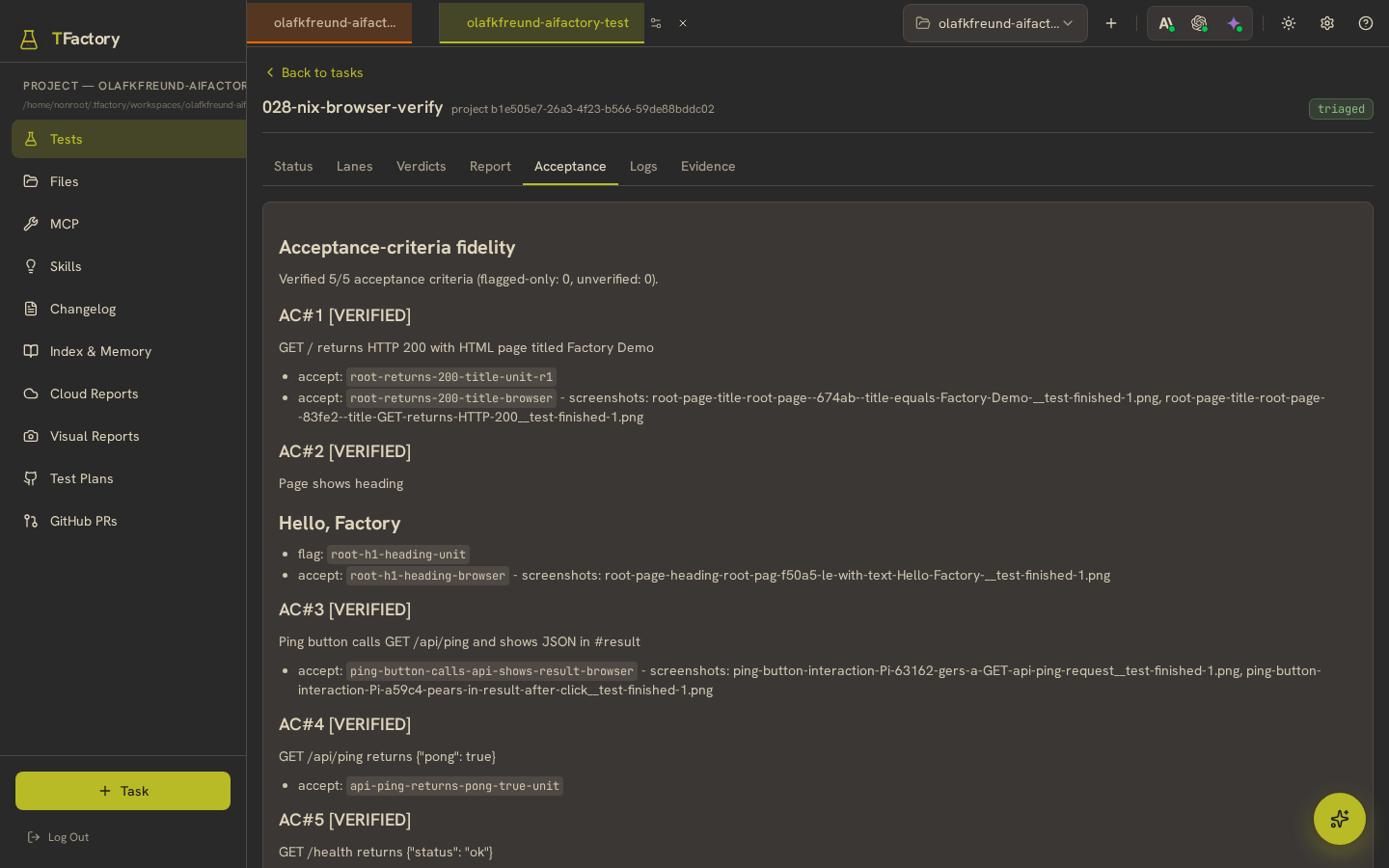
A green checkmark is not proof. For interactive acceptance criteria, the browser lane runs in a reproducible per-task Nix toolchain inside an ephemeral Kubernetes Job (RFC-0005 Tier A), drives the real deployed app, and captures a screenshot of the rendered page plus a recording of the test driving it. The Acceptance tab grades each criterion against a test that actually passed — an honest “verified X/Y”, never a blanket “done”:
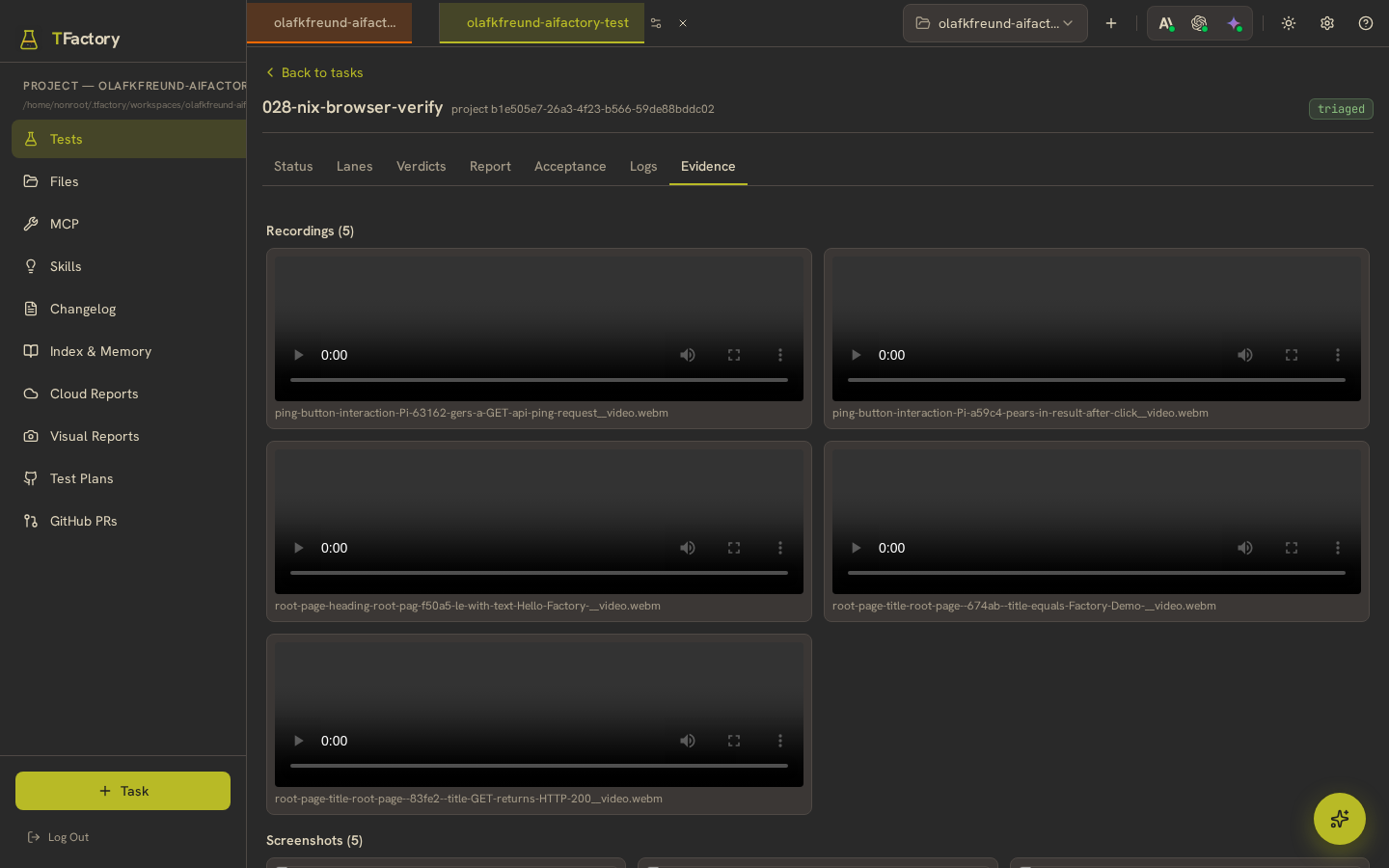
The Evidence tab renders the captured recordings and screenshots inline, so a reviewer can watch the test execute and look at the page it produced:
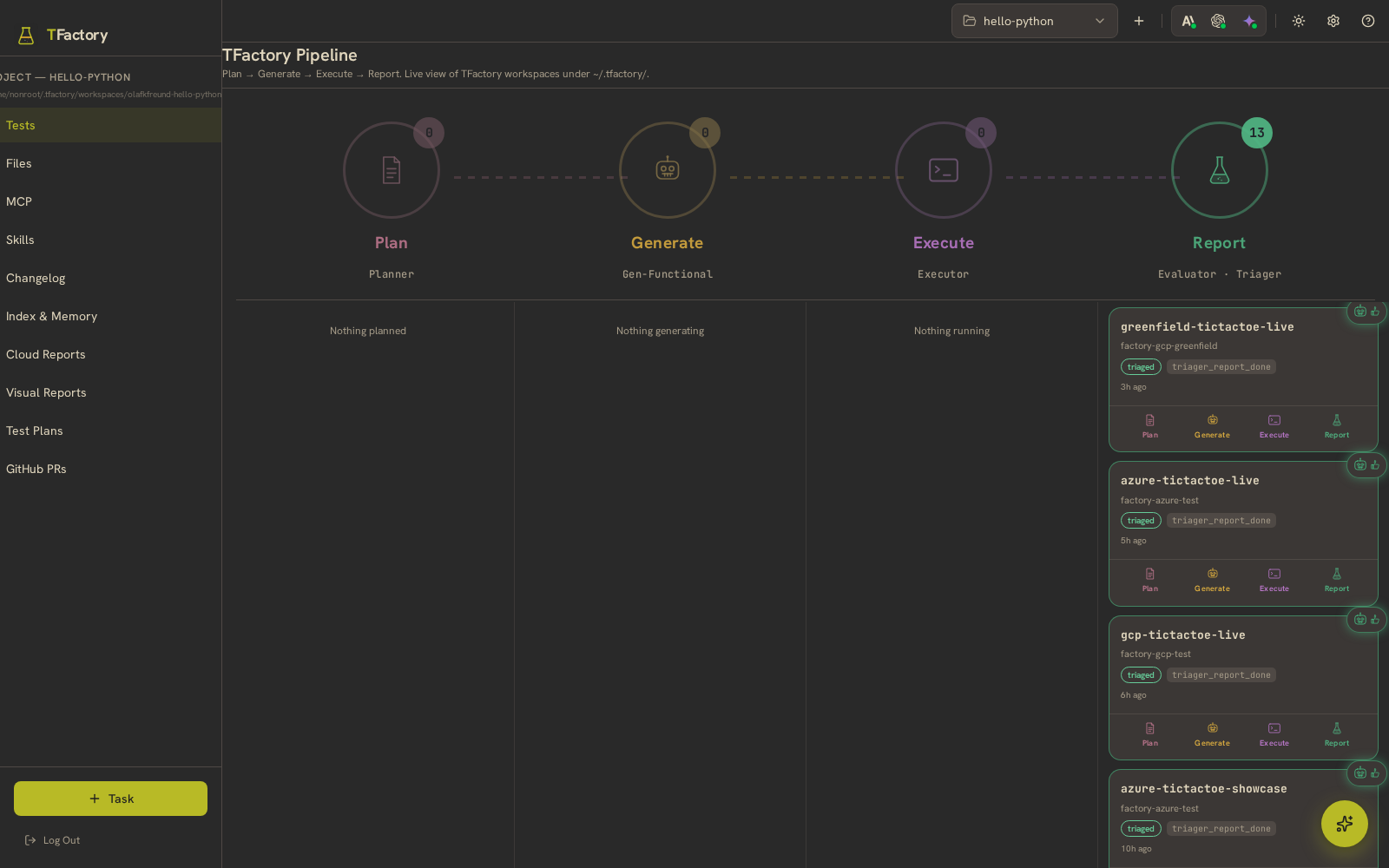
The whole pipeline — Plan, Generate, Execute, Report — is a live view in the portal, and the same evidence appears on the finished task in the CFactory cockpit:
Reach anything under test — including behind MFA
-
Authenticated and 2FA targets
The
.tfactory.ymlauth schema covers form, API-token, basic-auth and TOTP two-factor credentials with an ordered login-step flow. For MFA we do not bypass anything: the pipeline provisions a disposable identity provider, owns the OTP secret, generates valid RFC-6238 codes at fill time, captures the authenticated page, and tears the IdP down — zero production credentials. See how -
Credential Broker
Resolve secrets from a vault (Azure KV, AWS Secrets Manager, GCP Secret Manager, HashiCorp Vault) or local sops / age / agenix, materialise them ephemerally (0600, wiped per task), gated by an explicit egress opt-in with an honest manifest. See how
-
Kubernetes and SaaS
Log-in-once browser sessions (storageState),
type: kubernetesport-forward targets, and first-classtype: connectorSaaS targets (ServiceNow / Salesforce / SAP / MuleSoft). See examples
A governed node in the Factory line
-
Governed pickup from PFactory
TFactory enqueues governed test targets from PFactory, parses the planned acceptance contract as the test oracle, then generates, runs, and reports back up the spine. The contract — signed, with the deployed URL — travels with the work.
-
One completion event
The Triager emits a normalized RFC-0001 completion event with a shared
correlation_key, delivered at-least-once via a durable outbox and idempotency key, so the whole line speaks one schema and CFactory watches a single contract. See the envelope -
In the Backstage catalog
TFactory ships a
catalog-info.yamlplus TechDocs and is importable into Backstage, with enriched annotations and an AI-assistant skill descriptor — discoverable alongside the rest of the Factory.
Status by lane
The lane spine is modality-based (Decision 2). Security scanning is delegated to dedicated security pipelines and is out of scope here — TFactory focuses on functional and feature testing.
| Lane | Status | Runtime | Coverage | Evidence captured |
|---|---|---|---|---|
| Unit | Active | tfactory-runner-pytest + tfactory-runner-jest |
line (cobertura / lcov) | — |
| Browser | Active | Nix toolchain in a k8s Job (Playwright); host fallback where applicable | n/a (line coverage doesn’t apply when the test drives the browser) | screenshots, video, trace |
| API | Active | per-framework image + HTTP HAR recorder | line where the test exercises framework code | network.har |
| Integration | Active | per-framework image + AppRuntime (multi-service) | line where applicable | network.har, service logs |
| Mutation | Active | mutmut (Python) / Stryker (TypeScript) — one-mutation-per-run probe in the Evaluator |
reported per mutant (killed / survived) | — |
Each subtask’s lane is chosen by the Planner from its (language, framework) via
the framework registry; reviewers see the lifecycle phases
in the LaneStatusGrid and the per-test evidence in the Triager PR comment. New
languages and additional pipelines hook into the same five-lane spine through new
FrameworkDescriptors — no lane additions required.
Quickstart
# Clone and bootstrap (NixOS / flake-based)
git clone https://github.com/olafkfreund/TFactory
cd TFactory
nix develop
tfactory-minimal-venv   # creates apps/backend/.venv
tfactory-test           # backend suite, seconds
Full walkthrough in the repo README plus the end-to-end smoke guide for running real scenarios against an AIFactory project.
Documentation
-
Creating tests
Three ways in — a spec/issue, the portal wizard, or a handover — and every parameter.
-
Architecture
Directory structure, workspace layout, dataflow.
-
Design plan
Locked decisions, landscape research, risk register.
-
Showcase
The pipeline in action, with real captured evidence.
-
Technical spec
Per-component implementation detail.
-
Credentials and MFA
The Credential Broker, authenticated targets, and 2FA testing.
-
Test coverage
The TDD plan: unit / integration / e2e pyramid.
-
Progress
The live build log: closed tasks and commits.
-
Environment reference
Every environment variable the backend and portal read — default, purpose, and where it is read.
-
Changelog
Release notes and history.
Tracking
- Epic and sub-issues — github.com/olafkfreund/TFactory/issues
- Source — github.com/olafkfreund/TFactory
- Sister project (upstream) — github.com/olafkfreund/AIFactory
- License — MIT OR GPL-3.0